

Correct, Elegant, & Irrelevant: Why Technical ICs & Leaders Must Operate At The C-level
The middle of the business is disappearing. The work of translating technical truth into enterprise-wide commitment and conviction is not. It is moving onto the people closest to the work.

There was a time when the deal was clear. Executives and C-level leaders owned Why. Technical teams owned How. Between them sat a layer of directors, program leads, translators, and product operators who converted strategic ambition into decisions and decisions into work that turned ambition into results.
The arrangement was imperfect. It was often slow, political, and full of ceremony. But it carried meaning between the people deciding where the company was going and the people building what would get it there. That deal is breaking one layoff round at a time.
Technical individual contributors are feeling it first. AI is front of mind for C-level leaders and the board. Technical managers and individual contributors are being given more responsibility and accountability for business outcomes than ever. What they don’t get is influence.
The meeting arrives without context. Executives define their expectations for impact but offer no decision logic. A pilot gets funded, shipped, and then quietly dies because no one connected it to how the business actually creates value. The work was technically sound. The influence required to choose the right work never reached the layer where commitment and conviction happen.
This is why influence is no longer just a career accelerator for technical ICs and leaders. It is becoming part of the job, but no one is explaining it. C-level leaders are just expecting technical ICs to figure it out, without any guidance or support. Is it any wonder so many AI initiatives fail to deliver value?
This article is the support you should have been given and the explanation you deserve.
The Organizational Pyramid: Why, What, & How
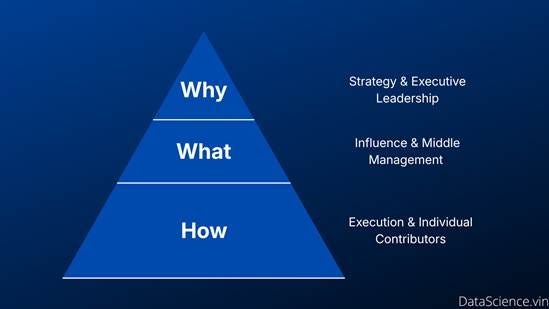
It’s useful to understand organizations through three layers.
‘Why’ is the strategic layer: priorities, constraints, bets, risk appetite, and executive judgment.
‘How’ is the execution layer: architecture, data, models, systems, technical trade-offs, GTM, and implementation.
‘What’ is the decision layer in between: what gets funded, what gets deprioritized, what counts as success, and what the organization will actually do next.
What is often reduced to a translation layer, but it is more than that. Translation just carries words across a boundary. The What layer also maintains commitment and builds conviction in both directions. It converts strategic intent into specific work and converts technical reality back into decisions the business can act on.
When the What layer is weak, companies build plenty, learn very little, and earn even less. Strategy floats above execution. Execution moves with local logic and fire-drill-driven prioritization. The result is a widening gap between what leadership believes the company is doing and what teams are actually shipping.
When the What layer is bloated, the opposite failure appears. Translation becomes ceremonial, and process overwhelms the gap. Competing agendas accumulate. Decisions slow down, and the work that survives often reflects organizational compromise more than customer or business value.
Healthy organizations need the middle. They do not necessarily need the old middle-manager structure, but they need the function. Someone has to connect Why and How well enough for consequential decisions to be made. Increasingly, that job is silently delegated to technical ICs and leaders.
The Middle Is Being Deleted
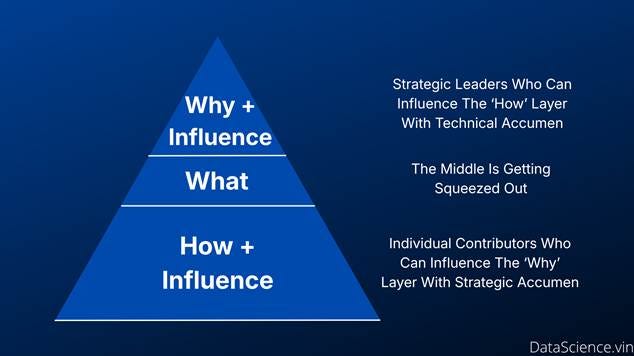
For a long time, that function belonged to someone’s job description. A whole layer of the org chart existed to package technical truth for executives and translate executive intent for technical teams. That layer is being squeezed out of the enterprise.
The numbers back that up. In Korn Ferry’s late-2024 survey of 15,000 workers across ten countries, 44% of U.S. respondents said their company had removed layers of management in the prior year. Bureau of Labor Statistics data shows managerial roles falling 6.1% between May 2022 and May 2025. Gallup’s measure of span of control rose from 8.2 in 2013 to 10.9 in 2024 to 12.1 in 2025, close to a 50% increase in just over a decade. Gartner projected that through 2026, one in five organizations would use AI to flatten structure and eliminate more than half of their middle-management roles.
Call it flattening, unbossing, or the rise of the supermanager. The pattern is simple. Fewer people are being paid to sit between strategy and execution. However, laying off the people who own ‘What’ does not delete the gaps the middle fills.
It only removes the people who used to absorb the ambiguity. The translation work now has two places to go: upward, onto executives who need enough technical acuity to shape the How, and downward, onto technical ICs who need enough strategic influence to shape the Why.
Most technical organizations are unprepared to fill the gaps. Influence used to move mostly horizontally inside functional layers. Architects influenced architects. Engineers influenced engineers. Now the valuable influence must move vertically. It crosses power, language, incentives, and decision standards.
Why This Is Becoming Urgent
This would matter even in a stable environment, but AI makes it unavoidable. The most important enterprise AI failures are translation failures, not technology failures. MIT’s 2025 State of AI in Business report found that roughly 95% of enterprise generative-AI pilots delivered no measurable bottom-line impact.
The easy interpretation was that the models do not work. The more accurate interpretation was that the work did not connect to the system of decisions around it. Tools missed the workflow. Pilots sat outside the operating model. Initiatives were funded as technology experiments rather than business changes. No one was listening to customers and learning about their emerging needs.
AI does not repair misalignment. It magnifies it. A company with poor decision flow now has faster ways to create impressive prototypes no one adopts, automations no one trusts, and dashboards no one uses to make decisions. Misalignment has forced C-level influence to become a technical skill.
The closer your work is to AI, data, platforms, infrastructure, or product architecture, the more likely your best work will fail for non-technical reasons. The technology isn’t feeble, but its capabilities were never translated into a C-level choice. We need to frame it as a risk worth taking, trade-off worth making, resource decision worth defending, and business outcome worth owning.
No one is coming to do that translation for you. In flatter orgs, the technical IC who can reach the Why layer becomes the key to technical value creation. The missing middle gaps are the driving force behind the rise in FDE roles and the restructuring of entire technical organizations.
The Training You Never Got
This is where technical careers collide with an unfair asymmetry. Executives are trained, formally or informally, in the mechanics of influence. They are coached to frame decisions, read stakeholders, use narrative design, manage trade-offs, and build coalitions. They learn that the shape of the conversation often determines the shape of the decision.
Technical ICs are trained in a different world. You learn to influence peers who share your standards of proof and decision-making process. You bring the evidence, explain the mechanism, show the trade-off, and expect the strongest argument to win. Inside the How layer, that works often enough to become an identity. Show your work, and the work should win.
But upward influence runs through a different operating system. Most technical people are never taught narrative communication or decision science. Both are critical for career success and longevity. They are told those skills are soft, political, or personality-based. The result is a convenient myth that some people are naturally influential, and the rest should focus on being right.
In reality, influence is not a personality trait. Research on leader emergence has repeatedly found communication skills to matter more consistently than extroversion. Extroversion may help someone enter the conversation. It does not teach them how to move a decision. Communication skills, narrative judgment, and strategic listening are built. The fact that technical people are rarely trained in them does not make them optional.
Why Evidence & Analysis Lose At The C-Level
The most important difference is sequencing, not communications style. At the How layer, we tend to assume a clean analysis loop. Evidence leads to analysis, analysis leads to a conclusion, and that conclusion leads to an obvious best decision. That loop is why technical people overprepare the proof. We think the answer is hidden in the data, so better evidence should move the room.
At the Why layer, the loop often runs in reverse. Senior executives frequently begin with judgment, pattern recognition, experience, and intuition, then use data to pressure-test or justify the choice. In PwC and the Economist Intelligence Unit’s survey of more than 1,100 senior executives, only about a third relied primarily on analytics for their last major decision. Intuition, experience, and the judgment of trusted advisors carried much of the rest.
Technical ICs and leaders must learn to appeal to intuition, match experience, and become trusted advisors.
This is not irrational. Executives make decisions in conditions where the evidence is incomplete, incentives conflict, risks are asymmetric, and timing matters. They are not only asking, Is this true? But also, What does this imply for the business? What changes if we believe it? Who has to own the consequences? What story does this fit, and what story does it break?
That is why flawless analysis can lose. If the executive’s mental model says the problem is adoption and your presentation proves a model is accurate, you are answering a question they are not asking. If their narrative says the company needs speed and your argument is built around quality, your evidence may sound like resistance even when it is the thing that would protect the bet they are making.
To influence the How layer, you improve the evidence. To influence the Why layer, you change the frame in which evidence is interpreted.
Narrative Is A Decision Operating System
This is where narrative communication stops being soft and becomes technical. Narrative is not a story you add after the analysis. It is the model that tells the decision-maker what the facts mean. Decision science is not a bag of persuasion tricks. It is the discipline of understanding how people make consequential choices under ambiguity, pressure, incentives, identity, and incomplete information.
There is a lot of junk around this field. Power posing, NLP, ego-depletion-style claims, and other confidently taught shortcuts have failed to hold up. The useful work is much less theatrical and far more practical. The Elaboration Likelihood Model for knowing when people will scrutinize an argument versus rely on cues. Narrative transportation for understanding why a story can shift beliefs in ways bullet lists cannot. Structured listening and nonjudgmental exchange for changing minds that fact-first argument often cannot reach.
None of this is manipulation. Manipulation hides the decision architecture from the person being influenced. Good C-level communication makes the decision architecture visible and aligns the evidence with it. It gives executives a better frame, trade-offs, language for risk, and a clearer path from technical reality to business commitment.
Technical people already do this kind of work with systems. We stop arguing with how we wish the system behaved and design for how it actually behaves. C-level influence is the same approach applied to the human decision system that operates above the work.
The New Technical Advantage
The next stage of technical influence will not belong only to the loudest people, the most senior people, or the people best at executive theater. It will belong to the ICs and leaders who can make technical truth usable at the top of the pyramid where resources, priorities, and narratives are set.
Those ICs will become unusually valuable because they solve a problem the new org chart created. They can see the How without being trapped inside it. They can enter the Why without bluffing like generalists. They can translate complexity into stakes, options, and decisions without stripping away the truth that makes the work matter.
That is not just a promotion path. This is how we protect the work itself. If you cannot influence vertically, your best work can still disappear into the gap. It can ship without adoption. We can win the technical argument and lose the funding decision. We can be correct, elegant, and irrelevant to the people deciding what matters next.
If you can influence vertically, you change what your company is capable of deciding. You become part of the missing middle rather than a casualty of its disappearance.
The Window Is Closing
The toughest part is that this shift is happening before most technical organizations have realized it exists in the first place. Companies are flattening, and AI is accelerating. Executives are asking technical questions with strategic consequences. Technical teams are being asked to justify strategic bets without ever being taught how strategic decisions are made. At the same time, the board is starting to worry about where their next generation of leaders will come from.
The technical IC and leaders who learn this layer early will look strategic because they can connect technical reality to C-level commitment. Those who wait will keep shipping strong work into a system that increasingly has no one assigned to carry its value upward. This is the emergence of the outcomes-based workforce and careers.
I learned these mechanics the hard way. Everything that made me effective inside the How layer failed when I tried to use it at the Why layer. I had to learn advanced narrative communications, decision science, stakeholder psychology, and executive framing from scratch to build a consulting practice and a community of founders, executives, and C-level leaders.
That is why I now teach C-level communications, influence, and presence as a discipline for technical ICs. I said I would never teach a class like this one, but here we are. In less than a year, influence has gone from a ‘nice to have’ capability to critical.
Not because technical ICs and leaders need to become executives, marketers, or politicians. The work now requires them to influence the layer where technical reality becomes enterprise-wide commitments. The question is no longer whether you are influential. It is whether you will learn the layer you were never trained for before the middle disappears completely.