

How Do We Fix This?

Right here. Right now. In times of fear, uncertainty, and doubt. This is when it’s possible to go from manager or director to C-level leader in a few years. These are the times when new thought leaders and $1,500-an-hour consultants are minted. You need what I call Framework Certainty to do it, but conditions are perfect right now.
These are the times when it’s clear the old ways aren’t working, so CEOs, board of directors, VCs, large investment houses…everyone is ready to try something different. The pain of continuing to resist change is higher than the pain of change and transformation.
$650 Billion
The amount Meta, Microsoft, Alphabet, & Amazon will spend on AI in 2026.
That’s only the first wave of AI TAM. If you can believe it, the waves that come next are even bigger. If AI is so big, why is everything losing money right now? Why aren’t investors buying it? Why aren’t we seeing more enterprise AI ROI? You know the answer if you have taken one of my courses at any point in the last 7 years. I can explain it with one line and framework.
We must only leverage information and AI for use cases where returns scale faster than costs.
Today, AI is being used for everything, and it has a very different cost structure than prior technology waves. As usage scales, so does cost. As use case complexity scales, so does cost. Low data and information quality scales cost. Inefficient model architectures scale costs.
I have been explaining a very specific paradigm in my articles and LinkedIn posts for almost 3 years.
Not every AI workload is economically viable.
The early winners of the AI cycle will focus on monetizing viable AI workloads. The losers will either try to monetize everything or attempt to monetize workloads with negative unit economics.
Wait, It’s All Opportunity Discovery & Use Case Selection?
V-Squared made $66,000 from 3 opportunity discovery workshops in January alone. I’m not bragging about revenue, just to do it. Businesses are willing to spend a lot on solving just this problem, and it isn’t a tough sell. The two bold quotes from the last section are my sales pitch.
If you want to fix AI FUD, use case waste, and endless PoCs, do two things:
Use AI When Returns Scale Faster Than Costs
Don’t Use AI When Costs Scale Faster Than Returns
If you’re not in a Big Tech company, the solution is literally that simple. I spend most of my opportunity discovery workshops explaining how to figure out which use cases will deliver the highest returns. The rest of the time is dedicated to defining the opportunity pipeline and teaching product managers how to get from opportunity to execution.
AI is an expensive technology, but it’s also capable of delivering massive returns. That’s how Walmart did it, and its stock just passed a trillion in market cap. They use AI to support the core business and extend its competitive advantages. Johnson & Johnson follows the same playbook, and it’s up 40% in the last 6 months alone.
Deere (John Deere) is up 16% in a month where big tech should be doing similarly well. Here is its AI story. It’s laughably boring by SV standards but incredibly effective for Deere’s customers. The only thing they do wrong is putting the technology story first, and making customers scroll to get to what really matters to large farming operations.
“We don’t create tech for tech’s sake. There’s a purpose behind everything we do, so that our customers have the tools they need to tackle some of the world’s greatest challenges.” John May, Deere’s Chairman & CEO
That’s the mindset winners have. Value companies are using boring AI to grow more efficiently than high-growth companies with cool AI stories. Here’s how you can too.
Start with novel customer value. What can AI do for our customers that we couldn’t do for them in the past?
Assess the monetization feasibility. Which of the novel customer value use cases align with the business model OR competitive strengths?
Assess cost and execution feasibility. Which use cases align with the business’s data advantages? Which technical solutions align with the business’s capabilities?
Prioritize based on value. What are our top 10 most lucrative opportunities that are monetizable and feasible?
Ensure that for each opportunity in the pipeline, returns scale faster than costs. That’s why upfront estimation, feasibility, road mapping, and iterative delivery are so critical. When AI initiatives follow a maturity model, value gets delivered each quarter, and something more important happens. You get feedback every quarter. What’s working? What is underperforming? What features aren’t reliable enough?
You also get the kind of data that’s treasure for model improvement. Expert feedback in the context of workflows is a more efficient way to improve model reliability than continuous retraining as new data comes in. This is just one of many flywheels I teach that reduce the cost and uncertainty around delivering AI products and platforms.
Inevitably, as the initiative progresses into later stages of technical maturity, it hits a plateau. The cost of the next incremental improvement is higher than the value it delivers. That’s when it’s time to shelve the initiative for the next opportunity in the pipeline. Quarterly delivery cadences prevent the business from spending too far into unprofitable initiatives.
What Comes Next For Tech Companies?
Today looks like a rebound, but not for most tech companies. Intuit and SAP are the only SaaS names I could find that are doing well today, even though the markets in general are bouncing back. Meta, Amazon, Microsoft, Alphabet, ServiceNow, and Salesforce are all flat or down right now. Of course, NVIDIA is doing well. Most of the massive spending that’s dragging everything else down is lifting its profit outlook.
No one’s making huge commitments to spend more on Azure or Agentforce or any of the others. Circular finance deals add risk to every startup’s announcement that they’re ramping up spending. However, this is also much bigger than just the hyperscalers and traditional SaaS vendors.
I was presenting about this yesterday. Uber is essentially SaaS for taxis. Instacart is SaaS for grocery delivery. PayPal is financial SaaS. Spotify is music and advertising SaaS. Robinhood is retail investor SaaS. Most haven’t fully explored the software platform rabbit hole yet. There’s a lot of risk left in the system, so we’re not done with the panic-selling part of this cycle.
Every company with a business model that relies on technology (which is now almost every company on Earth) must come to terms with the AI Monetization Pyramid. It’s one of the newest parts of my instructor-led AI Product Strategy Certification course.
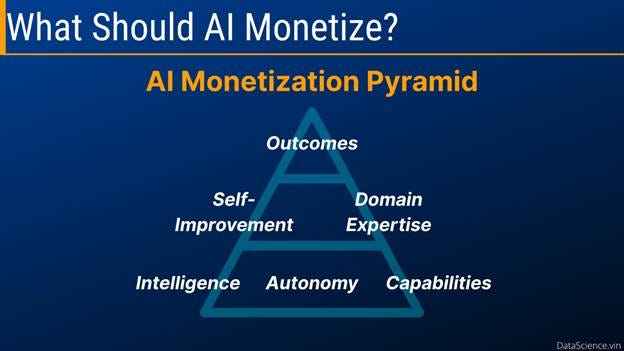
SaaS monetizes automation. The cloud monetizes compute. Neither business model works for monetizing AI, so there’s a lot of disruption still to come.
That’s the difference between tech incumbents and companies like Deere, J&J, and Walmart. Tech incumbents rely on their current technology-based business models for the majority of their revenue. Disrupting the business model’s current technology monetization paradigm means putting most of their revenue at risk.
Outside of tech, the business model’s reliance on technology is a much lower percentage of total revenue, so the disruption is easier to navigate. Getting traditional businesses to see the total opportunity size is a bigger challenge, but the AI hype cycle took care of that at many large corporations. That’s why Deere generates more profits with autonomous vehicles than Uber does. You’ll see more traditional companies successfully monetizing technologies that tech incumbents struggle with.
It’s ironic that SaaS companies have spent the last decade begging customers to embrace business model transformation to survive, yet when their moment comes to do it, they find themselves unable to rise to the occasion. I had hoped this would play out differently. The early signs of success were all there, but the commitment and conviction have been lacking.
